
Studying abroad has long been a dream for Indian students — a gateway to world‑class education, global exposure, and better career prospects. But in today’s world, marked by wars, geopolitical tensions, and uncertainty, that dream has become more complex.
From flight cancellations and visa anxiety to constant news alerts and family pressure back home, Indian students pursuing education overseas are navigating challenges that go far beyond academics.
Yet, despite the risks, they continue — showing remarkable resilience.
Why Indian Students Still Study Abroad During Global Conflict
For Indian students, overseas education is rarely taken lightly. It involves family savings, education loans, and years of preparation. Even during wars and political instability, many students still choose to go — or stay abroad — because:
- Competitive courses and research opportunities remain limited in India
- International exposure improves long‑term career prospects
- Returning mid‑degree is often financially impossible
- Universities abroad may offer better institutional support during emergencies
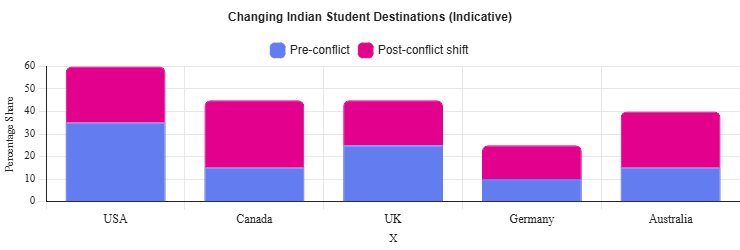
That said, destination choices have shifted. Countries perceived as politically stable — like Canada, Australia, Germany, and the UK — are increasingly preferred over regions closer to conflict zones.
Education is no longer just about ambition — it’s about safety and security.
Personal Stories: Indian Students Living Through Conflict
🎓 Ananya, MS Student in Germany
“When the Ukraine war started, nothing felt predictable anymore. Flights got expensive overnight, and my parents wanted me home. My university shifted to hybrid learning and offered counseling sessions. That support helped me stay and finish my semester.”
🎓 Rohan, Engineering Exchange Student (Eastern Europe)
“My internship was canceled because companies redirected resources during regional instability. Thankfully, my university helped me secure a credit‑transfer option instead of losing an entire academic year.”
🎓 Fatima, MBA Student in the UK
“The hardest part wasn’t assignments — it was watching the news at night and worrying about family while appearing ‘normal’ in class the next morning.”
These experiences are increasingly common. Even when students are physically safe, emotional and mental stress travels with them.
The Reality Indian Families Worry About
Unlike some cultures, Indian students rarely move abroad alone — emotionally or financially. Families remain deeply involved.
Common parental concerns include:
- What if flights are suspended suddenly?
- What if borders close?
- Will embassies help in an emergency?
- Is my child safe thousands of kilometers away?
These fears aren’t exaggerated. Wars disrupt air routes, banking systems, visas, and emergency services — sometimes overnight.
Visa Uncertainty: The Biggest Stress Trigger
During geopolitical tensions, visa rules often change abruptly. In recent years, students have faced:
- Delayed or suspended student visa interviews
- Sudden visa revocations
- Stricter background and social‑media checks
- Unexpected travel restrictions
For Indian students, visa trouble can mean:
- Losing non‑refundable fees
- Education loans without degrees
- Years of effort undone
- Emotional and social pressure
A visa issue isn’t just paperwork — it can change a family’s future.
Financial Pressure During Conflict
Most Indian students fund foreign education through:
- Family savings
- Education loans
- Property or gold mortgages
Wars often trigger:
- Currency fluctuations
- Higher tuition and rent
- Banking or remittance delays
- Reduced scholarship availability
Many students take on excessive part‑time work to cope — impacting academics and mental health.
Mental Health: The Silent Battle
Indian students abroad during conflict often carry a double emotional load:
- Academic pressure in a foreign country
- Constant anxiety about family, finances, or the future
Common struggles include:
- Sleep disruption due to time‑zone news monitoring
- Guilt for being safe while others aren’t
- Isolation and burnout
- Fear of visa or job loss
Universities offering culturally sensitive counseling and peer‑support groups see better student retention and recovery.
What’s Helping Students Cope: Real Solutions That Work
✅ University Initiatives
- Emergency scholarships and fee flexibility
- Hybrid or remote learning during crisis periods
- Trauma‑informed mental‑health services
- Flexible attendance and assessment policies
✅ Government & NGO Programs
- Emergency education pathways
- Refugee‑student and transfer programs
- Embassy helplines and advisories
✅ What Indian Students Are Doing
- Choosing politically stable destinations
- Tracking embassy updates
- Keeping all documents digitized
- Building Indian student peer networks abroad
Resources for Indian Students Affected by Conflict
🧠 Mental Health
- University counseling centers
- Online therapy platforms
- Peer support groups
💰 Financial Help
- Emergency bursaries
- Crisis scholarships
- University hardship funds
⚖️ Legal & Visa Support
- International student offices
- Indian embassy advisories
- Verified immigration legal aid
How Indian Students and Institutions Are Adapting
What Indian Students Are Doing
- Choosing politically stable destinations (Canada, Australia, Germany)
- Keeping digital copies of documents and emergency contacts
- Monitoring MEA and embassy advisories
- Prioritizing universities with strong international‑student support
- Building peer communities with other Indian students
What Universities and Governments Are Doing
- Emergency scholarships and fee flexibility
- Hybrid or remote study options during crises
- Trauma‑informed counseling for international students
- Refugee‑student and emergency‑transfer programs
Global organizations stress that protecting education during conflict is essential to preventing long‑term social and economic damage. [news.un.org], [worldbank.org]
Conclusion: Studying Abroad as Courage in Uncertain Times
For Indian students, traveling and studying abroad during times of war is no longer just about ambition—it is about resilience, calculated risk, and hope. Conflict may disrupt flights, visas, and plans, but it also reveals the enduring value Indians place on education as a pathway to stability and global citizenship.
As UN experts emphasize, education during conflict is not a luxury—it is protection, continuity, and resistance to uncertainty. [ohchr.org]
In a world shaped by wars and divisions, every Indian student who studies abroad carries not just a suitcase—but the weight of family dreams and the determination to build a safer future.
What You Can Do?
🎓 Students: Stay informed, ask for help early, and build support systems
🏫 Institutions: Prioritize flexibility and mental‑health access
🌍 Readers:
- Support organizations helping students from conflict zones
- Share this article to raise awareness
- Start conversations about education during crisis
Education during conflict is not a privilege — it’s protection and hope.
Join the Conversation 💬
Have you studied abroad during a war or crisis?
Share in the comments:
- What helped you cope?
- What support did you need most?
- What advice would you give future students?
Your story could help someone else feel less alone.
 Kairos Education
Leave a comment